Then Gradually Time Awakened Again and Moved Sluggishly on Is an Example of Which Literary Device?
Basic Types of Literary Devices
Saying "The bag is brown." is boring. However, adding literary elements like, "The oversized bag was a rich chocolate brown with gold trim." provides a lot more flavor to your writing. Explore more than than xl types of literary devices used in writing to add unique details.
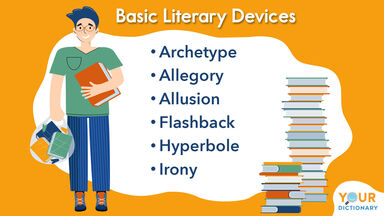 types of literary devices
What Are Literary Devices?
Literary devices are techniques a author uses to convey meaning to readers. An author's skillful utilise of literary devices allows readers to glean meaning beyond just what is denoted by the words on each page. Writers could convey meaning merely by relying on minimal literary elements similar plot, theme and setting, just that would not lead to the near interesting stories or poems.
That's where literary devices come in. They are similar the dressing, cheese and croutons that brand a salad and so delectable. They add season to writing like poetry and drama, which helps readers connect with the piece of work on a deeper, more than intimate level.
20 Central Types of Literary Devices in Writing
A single book or other literary work will include multiple literary devices, equally it more often than not takes several literary techniques to effectively communicate the overall significant of a piece of literature. Layering in literary devices leads to a richer experience for readers and writers alike.
Classic
In literature, an classic represents universal truths near homo nature or patterns that regularly occur. There are many examples of archetypes, including things like battles of skillful vs. evil, or never-before, first of their kind achievements. An archetype could exist a character, setting, situation, or symbol.
- The hero's journey, such as the situation in the Lord of the Rings series.
- An innocent character such as Pippin in Lord of the Rings.
Allegory
Do you like hidden meanings in stories? If and then, then an apologue is your type of literary device considering it uses symbols to reveal a hidden meaning that conveys the overall moral of the story. Many literary works comprise allegories.
- The Hunger Games is an allegory for reality Tv set and how it numbs us to horrors and suffering.
- The Panthera leo, the Witch and the Wardrobe has a bones religious allegory of good vs. evil or God vs. Satan.
Alliteration
A type of repetition, ingemination is when a letter is used repeatedly to add together emphasis and interest to a literary work. Sentences or phrases that accept several words that begin with the same alphabetic character are examples of alliteration.
- Sleepy sheep were shorn on Sunday.
- The big black bear banged blandly on the bark.
Allusion
An allusion is a passing reference in literature. It only involves making a passing reference to a person or another event in a story or other piece of work. It's a fun type of literary device that keeps writing from getting bland or boring.
- He was her Romeo. (a reference to Shakespeare'south Romeo and Juliet)
- It was like I walked into the Garden of Eden. (biblical innuendo)
Flashback
You have flashbacks in life. For example, the smell of baking cookies takes you dorsum to a time you spent with your grandmother. Flashbacks in literature are the same. These are story elements giving you insight into a previous moment or feel.
- Standing on the border of the cliff, she was all of a sudden transported back to the time when she was two. She remembered the feeling of her heart pounding as she looked down at the ground, seconds before falling.
- The loud clang of the thunder sent him spiraling dorsum into the state of war. He could remember every moment every bit the bombs raged around him. His captain screamed in his ear trying to become his attention.
Foreshadowing
Authors are sneaky. Sometimes, they give you merely a hint that something heady or foreboding is going to happen. This foreshadowing of the events to come up has united states tapping our anxiety in anticipation. Nearly every scary story or crime novel includes examples of foreshadowing.
- The still evening sent a chill downward her back. The air was just too calm.
- Looking away from her ill kid, she tried to tell herself everything would be okay, but she couldn't shake the feeling that danced in her stomach.
Hyperbole
Hyperbole is an extreme exaggeration used by writers to add emphasis to a phrase. While it is a fun literary device in literature, information technology's used in real life too. Discover examples of hyperbole and how to use it.
- I told y'all to practice the dishes a million times.
- My teacher is older than dirt.
Irony
Irony is nigh how your perception is different from how something really is. Irony has disappointed many readers when they idea something would happen, simply it didn't. At that place are several types of irony. Information technology comes in different forms like dramatic, verbal or situational irony.
- My old English mastiff dog is named "Tiny". (situational irony)
- My son is as innocent every bit the devil. (verbal irony)
Imagery
Imagery is the reason people enjoy reading fiction. Inside the pages of the book, you get transported to a new land or dystopian society. The sensory words the author uses to create that image in your mind are examples of imagery.
- The rich, warm smell of baking chocolate chip cookies reminded him of the soft smiling face of his grandmother.
- The blanket felt similar the fur of a g kittens.
Juxtaposition
Juxtaposition adds a unique twist to literature because it places two opposites next to each other. Examples of juxtaposition could exist positive and negative, like light or dark or yin and yang
- Don't make a mountain out of a molehill. (big vs. niggling)
- The immature child looked upward into the wrinkled confront of her grandmother grin. (young vs. old)
Metaphor
A metaphor is a figure of speech that creates a straight comparison. For example, saying, "the toddler was a devil" is an example of a metaphor. The toddler is not literally a devil; the metaphor is used to say that the child was behaving desperately in a figurative way.
- The kindergarten classroom was a zoo.
- The computers are dinosaurs.
Mood
Every literary work incorporates examples of mood to some degree. Mood sets the overall tone for a literary work. The words the author uses to create the mood can make the book happy or the vocal melancholy.
- In the Route Not Taken past Robert Frost, the verse form sets a gloomy mood.
- The song Skilful Vibrations by The Beach Boys has a happy mood.
Motif
Motifs are primal elements writers echo throughout a story. They are woven throughout a story and usually chronicle to 1 or more of a literary work's major themes. Motifs come in the form of symbols, objects, sounds, or fifty-fifty settings.
- Lord of the Rings repeats the use of lite and dark to signal practiced vs. evil.
- Harry Potter repeats the utilise of muggle vs. sorcerer born to illustrate racism and tolerance.
Onomatopoeia
While this i might look unfamiliar, you know what it is. Everyone is familiar with at to the lowest degree a few examples of onomatopoeia. It occurs when the proper noun of a word describes a sound, with the word itself sounding similar to the actual sound.
- The way the give-and-take splat is pronounced sounds very similar to the audio something makes when it splats.
- When you say the give-and-take woosh, it sounds very much like the audio something makes when it wooshes by.
Personification
Near people are familiar with various character and personality traits that people take. Writers capitalize on readers' prior knowledge by using examples of personification in their work. Personification involves giving the traits of a person to an inanimate object. It can be a fun literary device to employ.
- The car woke up with a grumble.
- The stars danced happily in the dark heaven.
Betoken of View
Writing tin be told from dissimilar points of view or perspectives. Writers utilise three different points of view: start, second and third person. The point of view used in a story greatly impacts how the story is conveyed.
- I scored the goal. (get-go person)
- You lot scored the goal. (second person)
- He scored the goal. (tertiary person)
Repetition
As a literary device, repetition is simply repeated words, letters, phrases, or sounds. Used correctly, examples of repetition in writing and poetry can push the message or point of the writing.
- Edgar Allan Poe's The Bells verse form repeats " Keeping fourth dimension, time, time."
- The "Let it snow, allow it snow, permit information technology snow" lyric in Dean Martin's Let It Snow is repetitive.
Symbolism
Symbolism is a fun literary technique. Writers employ this to add together pregnant to an object or person inside a story. Depending on the author's inventiveness, the level of symbolism tin be basic or unique.
- Red roses symbolize love.
- In Harry Potter and the Magician'southward Stone, the scar on Harry's forehead symbolizes non only his past but his future.
Simile
Looking to spark a trivial reader interest? Similes piece of work peachy for this because they make an interesting comparison between ii things using the discussion similar or as.
- The toddler is every bit stray as a devil.
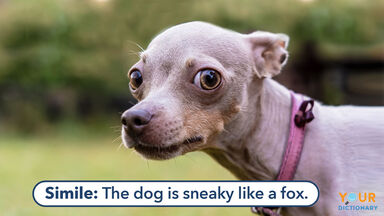
- The dog was sneaky like a flim-flam.
Tone
Has anyone ever reprimanded you for your tone? Tone tells us a lot virtually what a character is thinking or the feeling the verse form is trying to portray. In that location are many examples of tone, including a happy, energetic or even melancholy tone.
- Non even the brightness of the sun was plenty to cake out the dark cloud she could experience hovering over her head. (melancholy tone)
- The exhilarated daughter danced along the sidewalk making her way to her friend's firm. (upbeat, happy tone)
22 Additional Kinds of Literary Devices
Literary devices are everywhere. The examples higher up are used quite a bit, but they are certainly not the just ones. Notice less mutual, just still fairly basic, literary devices establish in writing.
- amplification - making something more than of import or larger
- anachronism - person or place in the incorrect fourth dimension period
- analogy - connections between familiar and unfamiliar things
- anaphora - repetition of a give-and-take at the kickoff of a passage or lyric to add emphasis
- anthropomorphism - when something nonhuman acts human
- asyndeton - removing conjunctions purposefully for effect
- colloquialism - adding informal or literal elements or words
- conceit - creating drastic comparisons
- epigraph - adding a quote at the beginning of a work
- epistrophe - repetition of words or phrases at the finish of the judgement or passage
- euphemism - polite words used in identify of harsh-sounding words (i.eastward. passing rather than death)
- malapropism - adding an incorrect discussion with like pronunciation
- metonym - using a linked term for a concept (i.eastward. pen for writing)
- oxymoron - using contradicting words
- paradox - contradictory statement that is truthful
- satire - works showing foolishness
- soliloquy - dramatic oral communication where a grapheme tells feelings
- synecdoche - using a role of an object to describe the whole object (i.e. wheels for a car)
- synesthesia - Mixing sensations
- tragicomedy - a slice of drama that mixes tragedy and comedy
- zeugma - using one word to hateful multiple things
- zoomorphism - animal characteristics given to objects or humans
Literary Devices vs. Rhetorical Devices vs. Figurative Linguistic communication
Are there differences between literary devices, rhetorical devices and figurative language? Now that is the question. Why? Considering the respond can become murky since these terms overlap. The easiest way to sympathise the difference betwixt literary devices, rhetorical devices and figurative language is to break each one down.
- Literary devices are an creative technique used in literature to add involvement and depth.
- Rhetorical devices are formative techniques used to evoke emotion or persuade. Rhetorical devices can be used as literary devices, only they are non limited to literature.
- Figurative language is a type of literary device that adds color to our writing. It includes simply isn't express to similes, metaphors, symbolism, hyperbole, and personification.
While these terms are different, the concepts of each intertwine and connect in writing.
Knowing Your Literary Devices
Literary devices might not seem important, just could you lot imagine writing without them. How tedious would that be? Now that you've mastered literary devices, explore examples of parallelism.
Source: https://examples.yourdictionary.com/basic-types-of-literary-devices.html
0 Response to "Then Gradually Time Awakened Again and Moved Sluggishly on Is an Example of Which Literary Device?"
Postar um comentário